UK drone class marking: what actually changes on 1 January 2028
There is a date in the UK drone rules that has not had much attention: 31 December 2027. That is when the arrangement recognising European class marks ends. A number of aircraft flying today under one set of permissions will, without changing in any way, be flying under a more restrictive set the following morning.
I have been working through what it means for my own fleet, and for the move into Specific Category operations I have underway. If you fly commercially in the Open Category, or you commission survey work from someone who does, it is worth understanding now rather than in late 2027.
The part that surprised me is that the aircraft most affected are not the ones that drop out of a subcategory. They are the ones that stay exactly where they are and quietly lose the distances that made the subcategory useful.
What class marking is
Since 1 January 2026, drones placed on the UK market carry a UK class mark: UK0 through UK6. The mark is not a quality rating. It determines which Open Category subcategory the aircraft may be flown in.
Broadly: UK0 and UK1 may be flown over people (A1). UK2 may be flown near people (A2), provided the pilot holds an A2 Certificate of Competency. UK3 and UK4 are restricted to far from people (A3), which in practice means 50 metres from uninvolved people and 150 metres from built-up areas. UK5 and UK6 sit outside the Open Category altogether.
The same date brought Remote ID for class-marked aircraft, Flyer ID from 100g, and a green flashing light for any Open Category flight at night.
Class | Max weight | Where you can fly now | From 1 Jan 2028, if C-marked |
|---|---|---|---|
UK0 / C0 | Under 250g | A1 — over people | A1 — unchanged |
UK1 / C1 | Under 900g | A1 — over people | A2, 50 m, with A2 CofC — loses A1 |
UK2 / C2 | Under 4kg | A2 — 30 m, or 5 m low-speed | A2, 50 m, with A2 CofC — loses 5 m |
UK3 / C3 | Under 25kg | A3 — 50 m / 150 m built-up | A3 — unchanged |
UK4 / C4 | Under 25kg | A3 — 50 m / 150 m built-up | A3 — unchanged |
UK5 / C5 | Under 25kg | Specific Category only | Unchanged — set by your OA |
UK6 / C6 | Under 25kg | Specific Category only | Unchanged — set by your OA |
From 1 January 2028 a C-marked aircraft becomes legacy and its limits are set by weight: under 250g A1, under 2kg A2 with an A2 CofC, under 25kg A3. A C2 aircraft over 2kg therefore drops to A3, not A2. Weigh yours as you fly it, payload included.
The transition that ends in 2027
Most aircraft sold in the UK over the past few years carry European C-class marks — C0, C1, C2 and so on — because manufacturers built to the EU standard and the UK had no equivalent. The CAA recognises those marks as equivalent to the UK ones until 31 December 2027. A C1 aircraft may be flown as though it were UK1.
That recognition is time-limited, and there is no indication it will be extended again.
What happens on 1 January 2028
From that date, a C-marked aircraft becomes a legacy aircraft. Legacy aircraft fall back to weight-based limits: under 250g may be flown over people, under 2kg near people with an A2 Certificate of Competency, and under 25kg far from people only.
The clearest way to see the effect is with three aircraft.
A sub-250g aircraft with a C0 mark is barely touched. Today it flies in A1. On 1 January 2028 it is a legacy aircraft under 250g, which also sits in A1. Nothing meaningful changes.
A 700g aircraft with a C1 mark loses a whole subcategory. Today it flies in A1, over uninvolved people. On 1 January 2028 the same aircraft, unmodified, is a legacy aircraft weighing 700g. The A1 privilege is gone. It falls to A2, which requires the A2 Certificate of Competency — and without that certificate, A3 only: 50 metres from uninvolved people, 150 metres from anything built up.
A 1kg aircraft with a C2 mark is the interesting case, and the one that gets missed. It does not change subcategory at all. With an A2 CofC it is in A2 today and it is in A2 in 2028. What changes is the distance. A C2 class-marked aircraft flown in A2 may currently go as close as 30 metres to uninvolved people, or 5 metres in low-speed mode. From 1 January 2028 that aircraft is legacy, and the A2 limit for a legacy sub-2kg aircraft is 50 metres.
Five metres to fifty. The subcategory is intact; the thing that made it worth having is not.
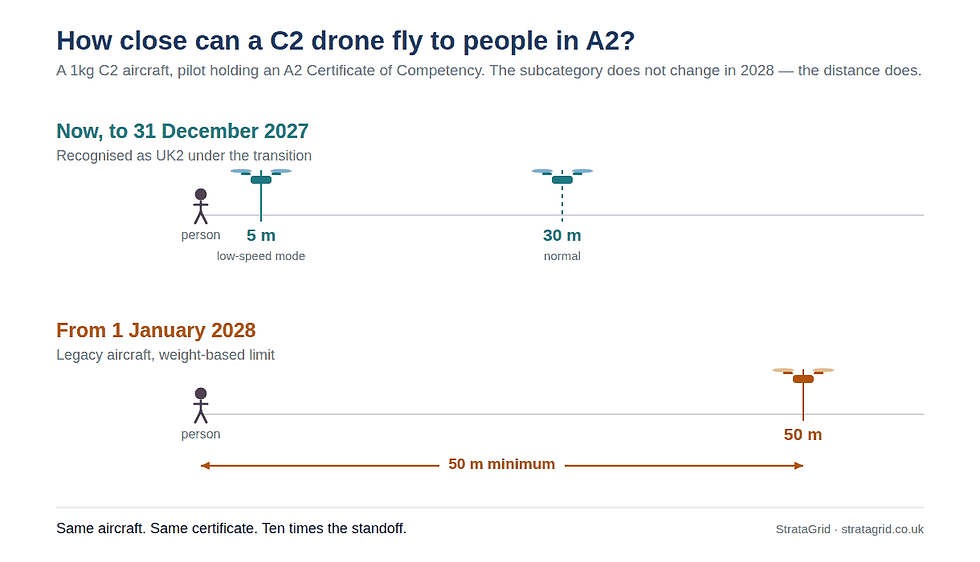
The same aircraft, the same certificate, ten times the standoff.
If your work involves flying close to a building with people around it — roof inspections, façade surveys, anything on an occupied site — that is the change that will actually cost you jobs, and it will not show up as a category downgrade on any checklist.
The same date brings a second requirement. Legacy and non-class-marked aircraft with a camera, weighing 100g or more, must broadcast Remote ID from 1 January 2028.
The Specific Category is not a shortcut
Class marks govern the Open Category. They do not set operating limits in the Specific Category, where the limits come from an Operational Authorisation and the operations manual behind it.
That sounds like an escape route, and in the long run it is the right destination for a lot of survey work. But it is not a quick fix for 2028. Getting there means a remote pilot certificate — the RPC-L1 has now replaced the GVC, which stops being issued at the end of 2027 — then a written operations manual, then an application to the CAA. That is a deliberate piece of work, not a form.
That is the route I am on. I hold the A2 Certificate of Competency, I am sitting the RPC-L1 shortly, and the operations manual and application follow from there. I mention it because the honest answer to "can I just get an authorisation instead" is yes — but start now rather than in the autumn of 2027, when everyone else has done the arithmetic and the training providers are full.
There is a second reason not to leave it. Dock-based aircraft, the kind that sit on site and fly a route on a schedule, are not Open Category equipment in any practical sense. If automated inspection is somewhere in your plans, the authorisation is not an optimisation. It is the thing that lets you buy the aircraft at all.
If you are buying equipment this year
Check what mark is actually on the airframe. A CE or UKCA mark is not a class mark — that catches people out constantly.
This is harder to act on than it sounds. Manufacturers are still shipping C-marked stock under the transition, and there is no public register of UK class marked products to check a model against. So the realistic advice is not "only buy UK-marked". It is to know which mark each aircraft carries, and to assume anything bought before UK-marked stock appears will be legacy from 2028.
There is a second trap. On several enterprise models the class label was never fitted at the factory. The Mavic 3 Enterprise and Matrice 30 series each needed a firmware update, an in-app application, a physical label kit, low-noise propellers and photo evidence submitted to the manufacturer before a certificate was issued. If nobody completed that process, the aircraft is not class marked, whatever the model is nominally rated for. Check for the certificate, not the model name.
Aircraft placed on the UK market before 1 January 2026 cannot be retrospectively marked. They are legacy permanently.
If you commission drone surveys
You do not need to track any of this. What you should be able to expect is that whoever flies for you can tell you, without pausing, which category a given job is flown under, what that permits, and how close the aircraft can work to your building, your site team or the public.
If the answer is vague, ask again.
Ewa Cielepa, StrataGrid. Aerial mapping, photogrammetry and inspection surveys, based in Southampton.


Comments